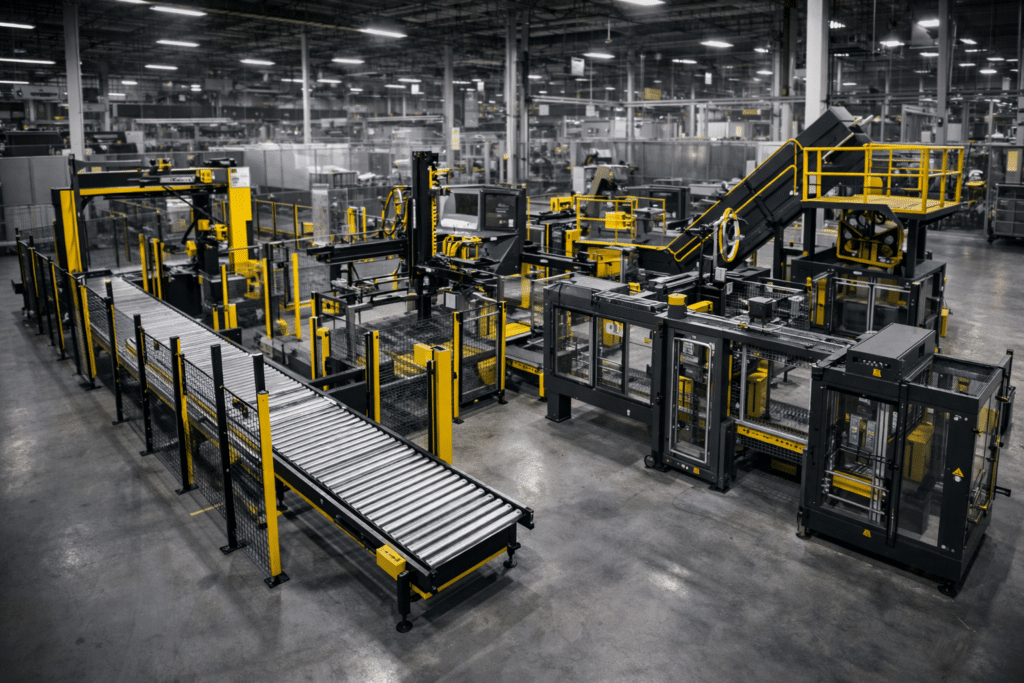
When managing an industrial project with several pieces of equipment, the question is not only about compliance.
The question is which framework applies and when to decide, especially in machine assembly scenarios and RD 1215/1997.
Sometimes it seems sufficient to apply RD 1215/1997 on equipment with individual CE marking.
However, if the integration creates functional safety dependencies, the figure of a set of machines may appear.
The difference is critical because it conditions the control design, automation and validation strategy.
And if decided late, corrections can be profound and costly.
RD 1215/1997 as a starting point
What does RD 1215/1997 actually cover?
RD 1215/1997 establishes the minimum requirements for the use of work equipment.
Applies regardless of whether the equipment has CE marking.
The focus is on actual usage, tasks, access and interventions.
Here, compliance is evaluated on the existing facility and its operation.
When RD 1215 may not be enough
In projects with several interconnected pieces of equipment, the analysis cannot be limited to each machine in isolation.
Joint behavior can generate risks that do not appear when evaluating separate pieces of equipment.
At this point, the question ceases to be only suitability for use and may enter the realm of functional integration.
Functional integration and machine assembly
What is meant by a set of machines
A machine assembly exists when several pieces of equipment, already individually conforming, are integrated and operate as a functional unit.
It is not enough that they are physically close.
There must be a relevant functional interdependence, especially in terms of security.
The role of the controller and the integrator
In most cases, the integration is not defined by the mechanics, but by the control.
A common PLC, a shared safety PLC or a global stop logic can transform several machines into a functional unit.
In this scenario, the figure of the integrator can assume responsibilities equivalent to those of the manufacturer with respect to the resulting set.
Technical framework for deciding: RD 1215 or overall analysisH3 – Situations where RD 1215 may suffice
It may be sufficient to apply RD 1215 when:
- The equipment operates autonomously.
- There are no safety dependencies between machines.
- Emergency stops are not interconnected.
- The failure of one piece of equipment does not affect the safety of another.
In these cases, the analysis focuses on use and appropriateness.
Situations where a set of machines may exist
The possible existence of a set must be analyzed when:
- A shutdown affects several pieces of equipment simultaneously.
- There are safety cross interlocks.
- Rearming is common.
- The control centralizes safety functions.
- The automatic sequence generates functional interdependencies.
Here, the analysis must be extended to the overall behavior of the system.
Expert checklist before closing the design
Before consolidating the control system, these questions should be answered with technical rigor:
- Is there a master control system that coordinates several pieces of equipment?
- Does an emergency shutdown affect more than one piece of equipment?
- Are there cross interlocks between different machines?
- Is the safety reset common to several pieces of equipment?
- Do safety functions rely on shared sensors?
- Are guards, fences or accesses shared between machines?
- Are there manual modes that enable coordinated movements?
- Are there automatic sequences with functional safety dependencies?
- Does a change in logic simultaneously affect several pieces of equipment?
Answering yes to several of these questions usually indicates relevant functional integration.
In this case, the normative analysis should not be postponed.
The right time to decide
The design phase as a critical point
The analysis can be performed at any stage of the project.
However, the right time is the design phase, when the control is still being defined.
At this stage it is possible to redefine architectures, functional boundaries and responsibilities.
In addition, the economic impact is controllable.
Analyze a posteriori
When the installation is already implemented, the analysis is still possible.
However, it may involve control redesigns, new validations and structural adjustments. In these cases it is usual to need a project of adaptation to RD 1215.
In some cases, the late decision may shift responsibilities not initially foreseen.
A structural decision of the project
The question is not whether the analysis can be done later.
The question is when critical decisions are made.
If the control defines the safety of the system, the evaluation should be performed when the control is still flexible.
Deciding whether to apply only RD 1215 or to analyze the possible existence of a set of machines is not a documentary procedure.
It is a structural decision of the project, and must be approached with technical criteria within the framework of the set of machines and RD 1215/1997.