
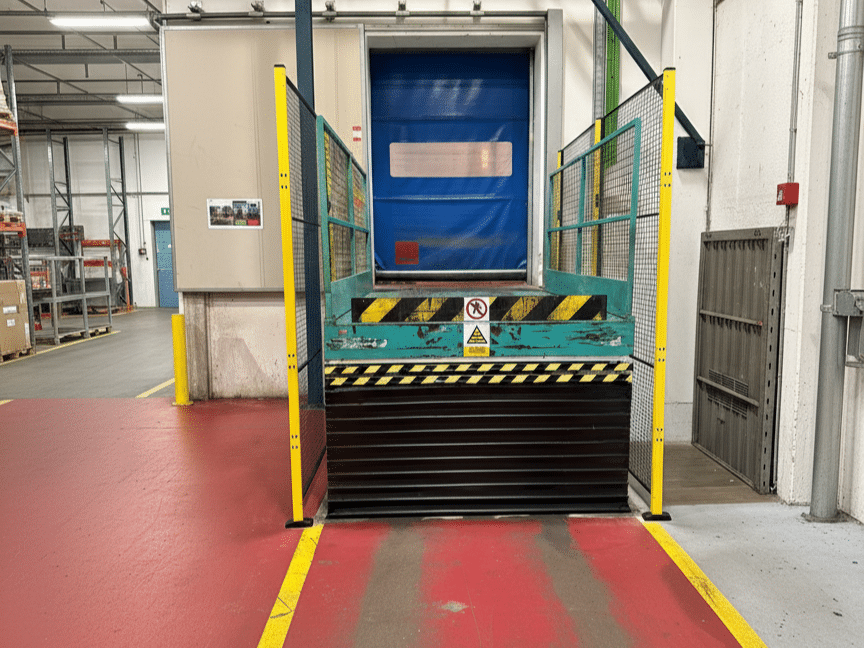
PRODEN GROUP has developed a project for the compliance of a lifting table according to RD 1215/1997 in a company of the automotive sector located in Sabadell.
The project was approached from the following areas ENGINEERING and later ADEQUAensuring a technical approach, progressive and aligned with current regulations.
In addition, the compliance of the lifting table according to RD 1215/1997 was designed considering the real use of the equipment and its integration in the production process.
Although this action was carried out in Sabadell, PRODEN GROUP develops similar projects throughout Catalonia.
ENGINEERING phase: technical analysis of the lift table
Risk assessment and regulatory requirements
First of all, the project was initiated from the ENGINEERING area, with a technical and preventive approach.
For this purpose, a risk assessment of the lift table used for load handling was performed.
Likewise, the minimum requirements established in RD 1215/1997 were verified. RD 1215/1997 and the applicable Harmonized Standards.
This analysis made it possible to identify the technical criteria necessary to define proportionate adequacy measures.
Definition of suitability criteria and solution design
Regulatory framework and technical references
Based on the previous analysis, adequacy criteria were defined in accordance with the reference standards.
Specifically, the following were considered:
- RD 1215/1997on work equipment
- Directive 2006/42/EC, relating to machinery
- UNE-EN ISO 12100, for risk assessment and risk reduction
- UNE-EN ISO 14120, about guards
- UNE-EN ISO 13849-1, for safety functions
In this way, a clear technical basis for subsequent actions was established.
ADEQUA Phase: execution of the conformity assessment
Technical actions implemented
Subsequently, the project advanced to the ADEQUA phase, with specific actions being carried out on the lifting table.
Among others, the following interventions were carried out:
- Installation of perimeter security fencing
- Incorporation of safety signage in accordance with regulations.
- Relocation of the electrical panel under the platform
- Design and installation of anti-trapping safety bellows
- Functional verification of the incorporated elements
These actions were carried out in a coordinated manner and aligned with the previous analysis.
Applied methodology: consistency between engineering and suitability
Technical continuity and traceability of the project
One of the key aspects of the project was the continuity between the engineering phase and the retrofit phase.
Therefore, consistency was ensured between the risk assessment and the measures finally implemented.
In addition, this approach made it possible to apply proportionate solutions, avoiding unnecessary oversizing.
All actions were developed with clear technical criteria and documentary traceability.
Project benefits
Improved operational safety
The project significantly improved safety conditions during the use of the lift table.
This reduced the risk of entrapment and access to hazardous areas.
Regulatory compliance
The performance provides a sound technical basis for justifying compliance with RD 1215/1997 and harmonized standards.
It also facilitates the management of future inspections and audits.
Integration in the production process
The adaptation was designed considering the actual operation of the facility.
Therefore, the implemented solutions maintain the functionality of the equipment and its productive availability.
PRODEN GROUP: engineering and adaptation of machinery in Catalonia
This project developed in Sabadell reflects PRODEN GROUP’s focus on safety engineering and work equipment adequacy.
Our team operates throughout Catalonia, accompanying companies in the industrial and automotive sector.