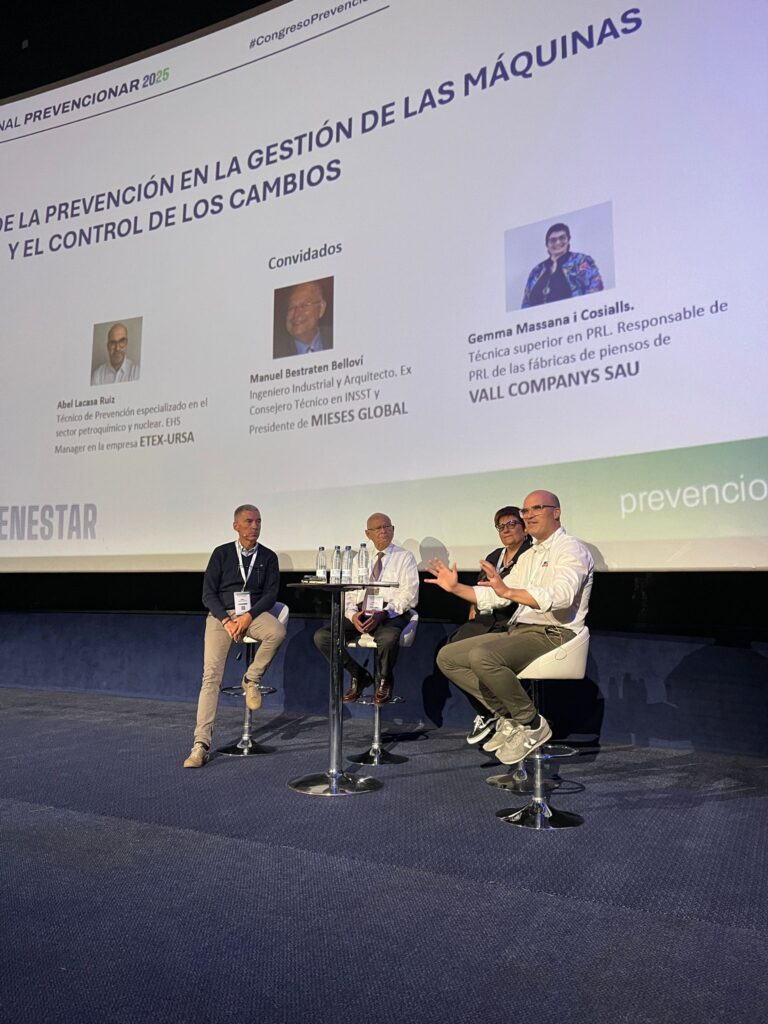
Key reflections of the round table of the Prevencionar Congress moderated by Joan Perona
In this article I share an introduction and an extended summary of the round table that I had the honor of moderating at the V International Congress Prevent 2025. A space that allowed to open debate on one of the great current challenges in industrial safety, :
How to ensure that prevention in the management of equipment and machines is integrated in a real and effective way in the management of work teams, machines and organizational processes.
The content of this article summarizes the main ideas, learnings and reflections that emerged during the session, but if you want to go deeper, I invite you to watch the complete intervention.
A panel of experts with complementary perspectives
I moderated a round table formed by three professionals of reference in the field of prevention and industrial safety:
- Manel Bestraten – Ex-conseller of the Institut de Seguretat i Higiene en el Treball.
- Gemma Massana – Head of Prevention at Vall Companys.
- Abel Lacasa – Head of Prevention at URSA – ETEX Group.
The most valuable thing is that each one contributed a different but totally convergent vision:
the Administration, the agri-food industry and the chemical sector agree that the integration of prevention can no longer be conceived as an add-on, but as a natural part of the management system itself.
If you want to know more about our experience helping companies in the real integration of prevention, you can explore who we are and how we work at PRODEN Group, where we combine engineering, regulations and preventive culture to transform industrial safety.
What does “integrating prevention” really mean?
To integrate is not to implant: it is to transform the culture.
Throughout the conversation, a recurring idea emerged:
integration is not about compliance, but about transforming the way decisions are made.
Integrating prevention into the management of equipment and machines implies that each area – production, engineering, maintenance, quality, purchasing, ORP – works under a common framework where safety is part of the design, planning and daily execution.
Prevention begins long before the machine arrives
We stress the importance of intervening from the design phase, even before purchasing or installing equipment.
As Abel pointed out, “what you don’t get right in the design, you pay for twice”.
And from a consulting perspective we confirm it:
an unsafe machine in the plant always involves costs, downtime, complex adjustments and, most critically, avoidable risks.
Key lessons that companies can apply today
1. Cross-cutting work is not an option: it is essential.
Gemma explained how, at Vall Companys, the best results have been achieved when all areas sit together from the beginning.
This transversality allows:
- Detect risks before they appear.
- Make sounder technical decisions.
- Align expectations between operations and PRL.
- Prevent future modification from driving up costs.
As a consultancy, we confirm that this is one of the points where we help the most: making it easier for the teams to understand each other and speak the same preventive language.
2. Standardize yes, bureaucratize no.
Abel provided a very practical reflection:
to proceed only with the critical.
In many sectors we see how an excess of documents generates confusion and demotivation.
In contrast, a clear standard – well thought out, well communicated and well reviewed:
- Order the activity.
- Allows for rigorous auditing.
- And it facilitates the actual integration of the worker into the safe operation.
Here, as a consultancy, we usually accompany by defining standards, critical task maps and behavior-based monitoring systems.
3. Training must be practical, continuous and linked to the command.
At the table we insisted on a key point:
real training does not take place in a classroom, but in the workplace.
Manel stressed the importance of involving the direct manager in both training and accreditation of employee competence.
It is the manager who observes, corrects and validates performance. And this, if well managed, improves:
- Preventive culture.
- The quality of the work.
- Operational autonomy.
- And early detection of deviations.
4. Occasional tasks are the most dangerous
One of the most powerful ideas that emerged is that serious accidents tend to occur in infrequent tasks, those that are not repeated every day and where trust plays tricks.
This reinforces the need for:
- Clear procedures for critical tasks.
- Specific training for non-routine situations.
- Periodic reviews oriented to real scenarios.
- Participation of the operator himself in the detection of risks.
This type of analysis is one of the most demanded services from companies, because it allows moving from a normative vision to an operational vision of security.
Why does integrating prevention from design improve profitability?
From a corporate perspective, integrating prevention is not only a technical obligation:
is a strategic decision.
Companies that work from the design phase achieve:
- Significant cost reductions by avoiding subsequent adjustments.
- Fewer plant shutdowns due to incidents or breakdowns associated with risks.
- Greater legal certainty, especially in the event of audits or inspections.
- Improved working environment and increased staff motivation.
- More competent and autonomous teams.
- More stable and reliable processes.
All this translates directly into productivity and competitiveness.
Looking to the future: a historic moment for industrial security
I closed the table with a reflection that I would like to repeat here:
We are at a historic moment in which integrating prevention into the management of equipment and machines can – and must – occupy the strategic place it deserves within the company.
Regulatory changes, digitalization, automation and the growing social demand for safe working environments mean that organizations are looking for consultancies capable of accompanying them, guiding them and accelerating this cultural transition.
As an industry, we have the responsibility – and the opportunity – to lead this transformation, helping to move prevention from being a requirement to being a driver of excellence.
See the complete session
If you want to go deeper, here is the full video of the round table.
If you would like to learn more about how we design and implement comprehensive technical solutions for machine safety and industrial environments, don’t miss our Engineering area – there you will find detailed information on engineering projects, regulatory compliance and specialized services.