Last May I was requested by the team of PREVENCIONARteam asked me for an interview to support the intervention that we will have on September 26th in Madrid.
The headline for the cover of the interview was The Integration of Culture, and Preventive Thinking, in Machine Safety Management and Change Control. The design PHASE.
We gave our point of view on how to achieve a real integration of prevention in the management of equipment and machines.
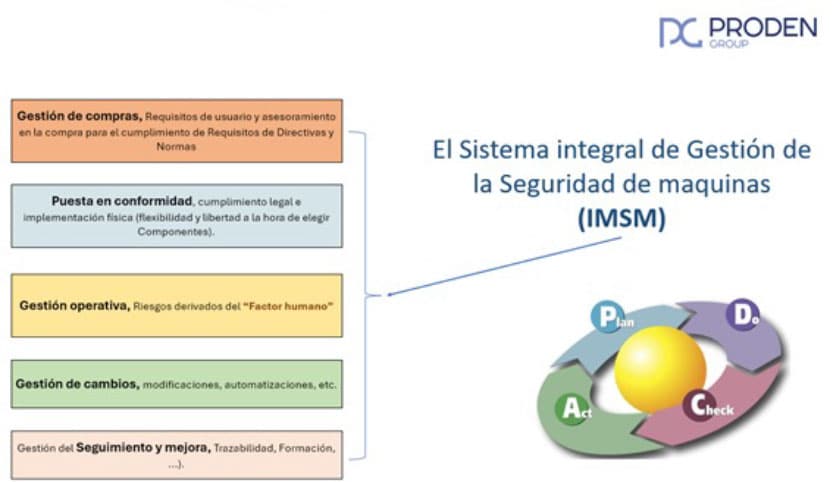
The key? A good Integrated Machinery Management System (IMSM) and evaluation at the design stage.
Industrial safety is a fundamental pillar in any industry. From your experience, what are the main factors that determine a safe and efficient work environment?
This is Preventive Culture. The main factor that determines a safe, efficient and sustainable work environment is the integration of the Culture and Preventive Thinking in the whole strategy of the Organization. If all the parties involved (Management, Prevention, Engineering, Maintenance, Users, etc.) think about Safety, a safe working environment will be practically guaranteed.
Working on machine safety in the embryonic STAGES of projects, if possible at the DESIGN stage, is working in a preventive manner and helps to create safe working environments.
The design of equipment and work environments plays a key role in risk prevention. What are the most critical aspects to consider in the design to ensure worker safety?
Most of the equipment (machines) are not considered dangerous (Annex IV of Directive 2006/42/EC or Annex I of the new EU Regulation 1230/2023) so the manufacturer self-declares the EC conformity with the requirements established in Directives and, in some cases, Harmonized Standards. We know that this is often not a guarantee of safety or compliance, so that the responsibility for safety, in these cases, is transferred to the company having to decide, in these situations, the need or not to perform subsequent actions that may involve substantial modifications and therefore the loss of the EC Declaration of Conformity, signed by the manufacturer himself.
A critical aspect is the fact that companies are unaware of the situations, or casuistry, in which these non-compliances can lead to unforeseen liabilities and mainly to unassessed risks that can result in unsafe work environments.
In many organizations, industrial safety is often perceived as an expense rather than an investment. How can this mindset be changed so that companies see the long-term benefits?
It is important to take into account the cost of “not doing” or the “reactive” cost that companies have once an accident has occurred. It is not only a matter of controlling tangible costs, but also of being able to value the “intangible” costs that tell us the impact that NON-safety can have on the company, in the medium and long term, in the eyes of its stakeholders.
Work teams play an essential role in occupational safety. What strategies do you recommend to foster a safety culture in teams and achieve their commitment to risk prevention?
All departments of an organization must be involved in safety. Training and information are basic for the teams to get involved, being clear about their respective responsibilities.
In many cases the lack of involvement is due to a lack of knowledge of these responsibilities. In the case of machine safety, working in the design and embryonic phases of projects, makes departments such as engineering and maintenance acquire an important implication, managing to work on new projects in a preventive and not corrective way.
In terms of training, how can a company best prepare its employees to identify and manage risks in their work environment?
Continuous theoretical and practical training, not only the strictly mandatory training in prevention but also in everything related to Industrial Safety (installations, machines, procedures, etc.) will help the workers of the Organization to acquire and internalize the preventive culture that will make all the parties involved to be aware of insecurities in the work environment.
What current trends are transforming industrial safety and which technological innovations do you think will have the greatest impact in the near future?
In the current context in which we find ourselves, we start from pre-existing safety conditions, which are constantly changing. New technologies bring with them new work systems and with them new associated risks.
Working conditions are changing and with it safety conditions.
In the case of machine safety the new trends have already led to the birth of the New EU Machinery Regulation 1230/2023, which will replace the current Directive 2006/42/EC, with the intention of providing a solution to the risks arising from the application of new technologies based on AI, IoT, autonomous driverless machines, Cobots, Cybersecurity, etc.
It is important to bear in mind that some of the new technologies may NOT guarantee compliance due to the fact that they are non-certified solutions and may make it difficult to comply with the security requirements of the Standard.
In view of the new machinery regulation and its new features, we should ask ourselves some questions when we start a project.
Is it a set of machines, according to the New Regulation?
What Essential Requirements do I have to meet?
Does any Harmonized Standard apply?
How do I solve the Agv-machine-person interaction problem?
Are they certified solutions?
Within the framework of the V International Prevencionar Congress, what are the main messages you wish to convey in your conference and why are they important for the attendees?
I would like to convey the importance of working on industrial safety, especially machine safety, in the embryonic stages of projects and even, if possible, at the design stage.
It is vital to have a good FUNCTIONAL SAFETY PLAN (FSP) in these preliminary phases that determines the different casuistry, functionalities and aspects related to the safety of the project, not only in terms of machine safety but also in relation to the safety of the processes and installations, if applicable.
Working in a preventive way, in project design PHASES, facilitates the integration of the Preventive Culture in the Organization, since the basis is the involvement of different transversal areas of the Organization such as Safety, Engineering and Maintenance.
Integrating industrial safety into design and production processes remains a challenge in many companies. How can safety be made a central component from the earliest stages of a project?
The most important point is that top management is involved and sees the value of working on machine safety in the design PHASES of the projects.
The cost of modifying new machines or manufacturing lines, after their purchase and reception, could be valued. Tangible” monetary cost and “intangible” cost, derived from the liability that may arise for the employer, or the technicians involved in the project, due to the fact of making modifications after the reception of such equipment.
The information and training of all the people involved is vital for the total integration of the preventive mentality.
In your opinion, which sectors present the greatest challenges in industrial safety and why?
All sectors, in general, present important challenges. More developed sectors such as Pharma and Automotive, due to the constant application of new technologies based on AI, IoT, etc. and the uncertainty that these technologies still entail in terms of security.
Then there are other sectors that are not so developed where the preventive culture is in its infancy and where the road ahead can be even more challenging and interesting.
For those who will attend the V International Prevencionar Congress, what key aspects should they take away from the event to apply in their organizations to improve industrial safety?
As the word itself expresses “PREVENTION” means “TO FORESEE” and to foresee means to take into account events or situations that may occur in the future.
The current mentality, as far as Machine Safety is concerned, is totally reactive, mainly due to the erroneous thought that the machines or manufacturing lines we buy are safe because they have an EC Declaration of Conformity issued by the manufacturer, when in fact it is a “self-declaration”, which does not always give a guarantee of compliance.
The key to success for Organizations is to get the teams involved in Industrial Safety to move from a reactive mentality to a Proactive mentality and to analyze and foresee the different possible situations and act accordingly in a preventive manner.
It is advisable, and almost essential, that the evaluation of compliance requirements be carried out, if possible, in the design phases, and before the purchase or reception of the machines, so it is of vital importance that these safety requirements be incorporated in the embryonic phases of projects. It is important to spend time working on a good Functional Safety Plan.
It is very important that companies are aware of the legal impact that the erroneous application of the Directives, Standards and the new EU Machinery Regulation 1230/2023 can have.
Be aware of the implications of making modifications (corrective actions, substantial changes, etc.) after receiving the equipment and the importance of change management in the face of new situations that arise.