
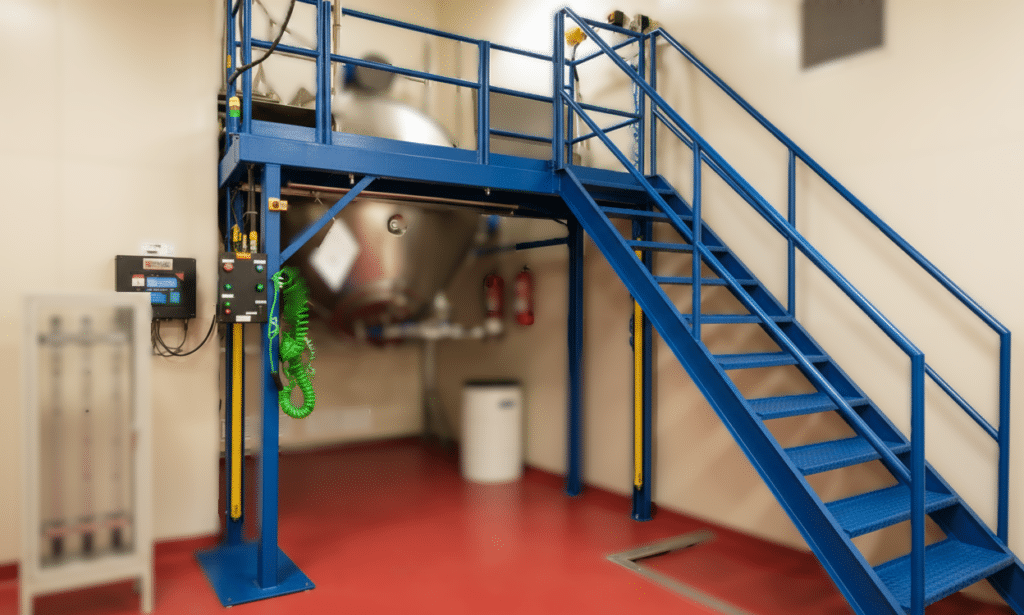
An industrial dryer engineering and adaptation project was developed according to RD 1215/1997, applied to a production equipment integrated in an industrial installation.
The project was approached progressively from the areas of ENGINEERING and later ADEQUAensuring technical coherence between analysis and execution.
In addition, the engineering and adaptation of the industrial dryer according to RD 1215/1997 was proposed considering the real conditions of use, operation and maintenance.
ENGINEERING stage: technical analysis of the industrial dryer
Risk assessment and conditions of use
First of all, the project was initiated from the ENGINEERING area, with a technical and preventive approach.
For this purpose, the industrial dryer, its accesses, areas of intervention and usual modes of operation were analyzed.
A risk assessment was also carried out in accordance with UNE-EN ISO 12100, applied to the equipment in its real context.
This analysis made it possible to verify the degree of compliance with the requirements of RD 1215/1997.
Definition of regulatory compliance criteria
Regulatory framework and technical references
Based on the initial study, technical suitability criteria were defined, based on the regulations applicable to work equipment.
Specifically, the following were considered:
- RD 1215/1997on minimum safety provisions
- UNE-EN ISO 12100, risk assessment and risk reduction
- UNE-EN ISO 13849-1 and 13849-2, functional safety
- UNE-EN ISO 14120, safeguards
- ISO 7010, safety signage
In this way, a clear technical basis for subsequent actions was established.
ADEQUA Phase: technical adequacy of the dryer
Implementation of security measures
Subsequently, the project advanced to the ADEQUA phase, with the execution of technical actions aligned with the engineering study.
Among others, the following interventions were carried out:
- Adequacy of safeguards and protections
- Improved access to intervention areas
- Integration of functional safety elements
- Hazard signage update
- Functional verification of implemented measures
These actions were executed in a proportionate and compatible manner with existing operations.
Methodology applied: continuity between engineering and suitability
Technical consistency and traceability
One of the key aspects of the project was the continuity between the engineering phase and the retrofit phase.
Therefore, consistency was ensured between the risks identified and the measures finally implemented.
In addition, this approach made it possible to avoid isolated solutions and to apply sustainable technical criteria.
All actions were carried out with technical and documentary traceability.
Project benefits
Improved equipment safety
The project improved the safety conditions of the dryer during normal operations.
This reduced the risk exposure of the personnel.
Regulatory compliance with RD 1215/1997
The performance provides a sound technical basis for justifying compliance with RD 1215/1997.
It also facilitates the management of future inspections and revisions.
Solution adapted to actual use
The suitability was designed taking into account the effective use of the equipment.
Therefore, priority was given to functional and sustainable solutions.
Engineering project and adaptation of machinery in Catalonia
This project reflects the approach applied in engineering works and adaptation of machinery according to RD 1215/1997.
This type of action is carried out throughout Catalonia, adapting to each equipment and context of use.